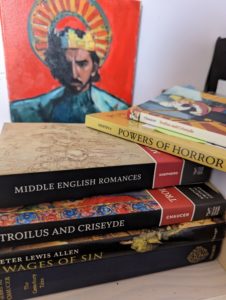
The aim of my thesis is to develop critical approaches to concepts of gender, space and place so I can form a comprehensive comparative study between two medieval texts: Geoffrey Chaucer’s Troilus and Criseyde and Robert Henryson’s Testament of Cresseid. By assessing the construction of these concepts individually in the respective poems, I believe I will have laid down a foundation where the interplay between the three will become evident. I will be utilising techniques of literary analysis, namely close reading and reading with and against the grain to argue just how closely these two poems are connected.
The 1532 Thynne Edition, titled The Workes of Geffray Chaucer, is the earliest printed version that Henryson’s Testament of Cresseid was found in. It is notably appended to the end of Troilus and Criseyde and its authorship was mistakenly attributed to Chaucer for most of the sixteenth century. There is a visible thematic cohesion between these two texts, which I argue is not entirely accounted for via the reasoning of careless collation.
Regarding the primary texts, the editions I will be relying upon for the duration of my thesis will be the Norton Critical Edition of Troilus and Criseyde. I find it to be the most relevant to my area of research, as Robertson’s Testament of Cresseid is appended to the end of the book. Digital editions of the primary texts will also be included because of their user-friendliness: specifically, I will be utilising Agnes Scott College’s digital version of Troilus and Criseyde developed by Stephen R. Guthrie, and a digitally formatted Testament of Cresseid found on the University of Rochester’s website.

As a starting point for my research, I will be consulting Judith Butler’s book Gender Trouble: Feminism and the Subversion of Identity. It will serve as a primary framework in deconstructing the binaries of gender identity that have been precariously built by Chaucer in Troilus and Criseyde. As a poem centred around the theme of human uncertainty, the work Butler has published will greatly aid in my argument that this emphasis on uncertainty in Troilus and Criseyde can, and is, extended to gender identity. Butler’s theories on gender performance also align with how gender identity is constructed within Troilus and Criseyde: that is, the idea that masculinity and femininity are performed and ultimately politicised. Simone de Beauvoir’s theories of constructed womanhood and the postulation of woman as “other” in her book The Second Sex will be invaluable building the framework of how Cresseid is effectively othered in Henryson’s poem. Although the scope of my thesis is planned to be gynocentric – revolving around Criseyde/Cresseid and her identity, spaces she inhabits and the eventual liminality of her existence in Testament, it would be amiss to neglect the scholarship that has been conducted around masculinities. The essays within the book Men and Masculinities in Chaucer’s Troilus and Criseyde will be the main references for my construction of masculinity and its downfalls (Martin 132-147): in particular, how masculinity is defined and aligned with Butler’s theories of gender performance. (Pugh, Calabrese et. al 1-8) The book also contains chapters which will be helpful for framing discussions of the interplay between gender and space within Troilus and Criseyde’s dream-visions. (Koppelman 97-114) I will also be discussing David Benson’s chapter in The Chaucer Review, where he advocates for a re-examination of Troilus in the Testament of Cresseid, where scholarly interest in him is regularly eclipsed by the work done on Cresseid.
Liminal theory plays a big role in my thesis: it will be applied to illuminate how the gender binary in Troilus and Criseyde is queered and will be additionally used to define space and place in my thesis. Victor Turner’s The Ritual Process: Structure and Anti-Structure is going to serve as the foundation in adapting my own applications for liminality in literature, shifting away from the anthropological and ethnographical focus of his work. This theory will primarily be explored in The Testament of Cresseid, where transitional places and the movement between fixed places are central to the plot of The Testament of Cresseid. It is also applicable to Cresseid and her physicality: she becomes a vessel, a space to harbour disease. There are similarities between physical illness and disability in the poems that require historical context. Peter Lewis Allen’s The Wages of Sin: Sex and Disease, Past and Present, particularly the chapters “Sex by Prescription: Lovesickness in the Middle Ages” (1-24) and “To Live Outside the Camp: Medieval Leprosy” (25-40) are going to be a staple for my research, providing invaluable cultural context and insights into social attitudes around disease. I will also be using Julia Kristeva’s Powers of Horror to provide a plausible outlining of Cresseid’s psychological processes. Kristeva’s abjection theory is especially relevant in outlining Cresseid’s death-denial and self-abjection over the course of the poem. The abject and the liminal operate well together, sharing similarities in their conceptualisation of the threshold and rites of passage.
There is a liminality of genre that is evident within Troilus and Criseyde: the conventions of courtly romance and the heavy influence of Boethius’ Consolation of Philosophy are at odds and almost seem irreconcilable in their fight to have a place in the narrative. To consider these idiosyncrasies in a meaningful capacity, one must appraise these genres individually before being fully able to appreciate how they collide with one another. The critical essays in Middle English Romances, especially Finlayson’s “Definition of Middle English Romance” (428-455) and Baugh’s “Improvisation in the Middle English Romance” (456-497) have provided me with a good starting point in approaching medieval genre studies. Kendra’s chapter “Tied in ‘Lusty Leese’: Gender and Determinism in Troilus and Criseyde” in The Chaucer Review has been especially helpful, as it links the dialectical tension between Boethianism and agency to gender, which is pertinent to the bridging of concepts I wish to accomplish in this thesis.
Uncertainty is ironically the most persistent theme of Troilus and Criseyde and The Testament of Criseyde. There have been publications on the effects this liminality of genres has on the characters proper in Troilus and Criseyde, but they do not cross the threshold into comparing the poem with The Testament of Criseyde. I believe that Testament is to the Troilus what Wide Sargasso Sea is to Jane Eyre: a response to the original text that places them in dialogue with one another. They have much to offer when considered as a whole, but I’m convinced that they are even richer texts when evaluated together rather than divided separately.
References
Allen, Peter Lewis. The Wages of Sin: Sex and Disease, Past and Present. University of Chicago Press, 2000.
Beauvoir, Simone de. The Second Sex. Vintage, 2010.
Benson, C. David. “Troilus and Cresseid in Henryson’s ‘Testament.’” The Chaucer Review, vol. 13, no. 3, 1979, pp. 263–71. JSTOR, http://www.jstor.org/stable/25093465. Accessed 8 Apr. 2023.
Butler, Judith. Gender Trouble: Feminism and the Subversion of Identity. Routledge, 2006.
Chaucer, Geoffrey. Troilus and Criseyde. Edited by Stephen A. Barney, W.W Norton & Company, Inc., 2006.
Chaucer, Geoffrey. “Chaucer’s Troilus and Criseyde.” Edited by Steve R. Guthrie, Troilus and Criseyde, 2014, https://www.agnesscott.edu/english/troilusandcriseyde/.
Henryson, Robert. “The Testament of Cresseid.” Edited by Robert L. Kindrick, The Testament of Cresseid | Robbins Library Digital Projects, 1997, https://d.lib.rochester.edu/teams/text/kindrick-poems-of-robert-henryson-testament-of-cresseid.
Koppelman, Kate. “‘The Dreams in Which I’m Dying’: Sublimation and Unstable Masculinities in Troilus and Criseyde.” Men and Masculinities in Chaucer’s ‘Troilus and Criseyde’, edited by Tison Pugh and Marcia Smith Marzec, Boydell & Brewer, 2008, pp. 97–114.
Kristeva, Julia. Powers of Horror: An Essay on Abjection. Translated by Leon S. Roudiez, Columbia University Press, 1982.
Martin, Molly A. “Troilus’s Gaze and the Collapse of Masculinity in Romance.” Men and Masculinities in Chaucer’s ‘Troilus and Criseyde’, edited by Tison Pugh and Marcia Smith Marzec, Boydell & Brewer, 2008, pp. 132–147.
Pugh, Tison, et al. “Introduction: The Myths of Masculinity in Chaucer’s Troilus and Criseyde.” Men and Masculinities in Chaucer’s ‘Troilus and Criseyde’, edited by Tison Pugh and Marcia Smith Marzec, Boydell & Brewer, 2008, pp. 1–8.
Shepherd, Stephen H.A. Middle English Romances. W.W. Norton & Company, 1995.
Slayton, Kendra. “Tied in ‘Lusty Leese’: Gender and Determinism in Troilus and Criseyde.” The Chaucer Review, vol. 54, no. 1, 2019, pp. 67–90. JSTOR, https://doi.org/10.5325/chaucerrev.54.1.0067. Accessed 8 Apr. 2023.
Turner, Victor W. The Ritual Process: Structure and Anti-Structure. Aldine De Gruyter, 1995.