Imagine this scenario. Someone you’re talking to relays to you a piece of information that has you reeling. Not because it’s a personal, devastating piece of news. Or anything along that vein. You’re shocked because you wonder just where that person got that information from. It could be your uncle raving on about how the Pfizer vaccine’s secretly a microchip with GPS installed so “Bill Microsoft” can track your every movement. Or someone dubious at the pub drunkenly rambling at you that “they” found giants tucked away in Agartha, the society hidden in the core of the earth in lieu of, you know. What most of us would expect. Something like Magma. Oh, and they found Agartha too. That was implied somewhere. I’m being (mostly) hyperbolic, but chances are you’ve probably met someone like this.
With the advent of the Internet comes an influx of information made publicly available to anyone with dial-up: it is a double-edged blade when you think about the quality and reliability of it. It has always been true that reporting news or relaying any sort of information is going to be riddled with human error. There have been concerns about objectivity in news-reporting and there always will be. The Internet, in terms of the wealth of the information it contains, is either a net-positive or a net-negative, depending on who you ask. We are now able to type in words through a search engine and access what we’re looking for at the click of a button, optimal in its specificity. This is a great feat for accessibility. Especially when compared to our parents, where information would have to be sought out manually; located through the library or bought books and newspapers. As a disclaimer, I would like to note that what is contained in said books are not perfectly objective and reliable, either. I’m not trying to romanticise the past, but rather trying to highlight how the vast amounts of information the Internet contains has led to increasing discourse over what is considered to be “good” knowledge and “bad” knowledge. Scientific studies and academic papers that have been published are, more often than not, locked behind a paywall. Access to these materials are significantly more limited than dubious, borderline conspiratorial content that is rife, free, and moreover easy to find since there are no restrictions to bypass.
So, how does Wikipedia tie into this? We’ve all heard of teachers (mainly in secondary school) try to deter their students from utilising it and dismissing it as a place with “bad” information because, in their words, “anyone can edit it.” They are correct, in that regard: Wikipedia’s website itself that it is “a free online encyclopedia written and maintained by a community of volunteers.” Nor are they wrong in implying that since it is available to be edited by anyone, there can and will be cases where someone will take the time to purposely put misinformation on certain pages. Wikipedia refers to this process as vandalism. Be that as it may, “anyone” also includes aspiring academics and postgrads (us!) in their demographic, who hope to positively contribute to this public encyclopedia. With the help of Dr. James Smith and Dr. Maureen O’ Connor, our MA class participated in the School of English’s annual Wikithon, this year livetweeted and can be found by entering #EditWikiLit in the searchbar.
My twitter account can be located here, (or @lavorocke if the hyperlink somehow fails on me) and documents my editing process. I had chosen to contribute to The Book of Margery Kempe Wiki Page, which seemed rather sparse at the time compared to the Margery Kempe page itself. I had felt as though some of the elements of the author’s page should have been moved to the page about her book, but that had to involve a request and multiple discussions around approving this decision. I would not be capable of successfully conducting this in a two hour window, so I was mindful about editing the page in such a way that would aid students: enriching the page by adding sources and narrowing down the search for sources within the book itself with chapter specifications. I also offered an explanation on the rhetorical technique used in the book, since the previous contributor made an insufficient, infallible statement. There were also codicological descriptions and notes on form that I had added to the page that were not previously entered. Below are embedded tweets detailing the changes I have made:
Here is the finished result, compared to the original page before the Wikithon began.

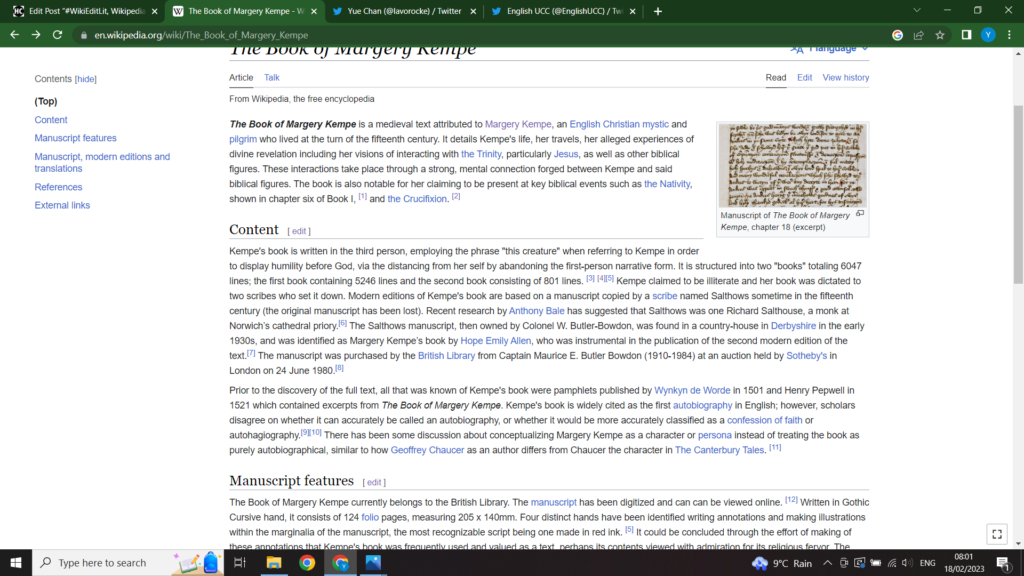
Some things I forgot to mention during the Wikithon is how nice it is that there is now a Visual Editor for Wikipedia now, instead of having to string some code together to be able to contribute Wikipedia. It’s a nice touch and makes for a good way to garner volunteers who may not be tech savvy but still wish to make edits. I was also surprised at how little I was able to add: I didn’t expect the editing process to be time-consuming, but I found myself rushing to finish a section at the end of the two hour session.
Editing Wikipedia has ultimately made me reflect on the topic of knowledge and sharing it. I am grateful for people who have taken the time and effort to put valuable information on it that would otherwise be difficult to locate. If you have specific knowledge about a topic, why not share it? It might be useful.